BMW: The Complete History of Bavarian Motor Works
BMW: The Complete History of Bavarian Motor Works

BMW is one of the most iconic names in the automotive world, but the company’s history reaches far beyond the elegant sedans, straight-six engines, and high-performance M cars that made it famous. The story of Bayerische Motoren Werke is a story of reinvention and endurance, one that begins not on the road but in the air. Long before BMW became associated with premium sports sedans and the phrase “The Ultimate Driving Machine,” it was a young industrial company trying to establish itself in the technically demanding and politically volatile world of aircraft engines. That beginning mattered. It helped form the culture of engineering rigor, efficiency, and mechanical ambition that still defines the brand today.
The roots of BMW trace back to Munich in the 1910s, when German aviation was developing rapidly and industrial companies were racing to supply ever more advanced components. BMW’s lineage runs through companies such as Rapp Motorenwerke and Bayerische Flugzeug-Werke, and by 1917 the name Bayerische Motoren Werke had officially emerged. In those early years, the company’s reputation was built around aircraft engines, not automobiles. This origin is not simply a historical curiosity. It explains why BMW’s identity always had such a strong technical dimension. The firm’s earliest challenges involved power, reliability, weight, efficiency, and performance under severe conditions — the sort of engineering priorities that would later shape its cars and motorcycles.
One of the most important early products was the BMW IIIa aircraft engine, a design associated with Max Friz. It became known for strong performance at altitude and helped establish BMW as a serious engineering company in an era when aviation technology demanded exceptional precision. Even before the company had a stable future as a carmaker, it was building a reputation for technically sophisticated powerplants. That heritage would remain part of BMW’s mythology for generations.

The end of the First World War forced the company into its first great reinvention. Germany’s defeat and the restrictions that followed meant that the manufacture of aircraft engines could no longer remain the company’s core business. For a young engineering firm built around aviation, that was an existential problem. BMW had to survive by redirecting its mechanical expertise into other products, and this process gradually brought the company toward motorcycles.
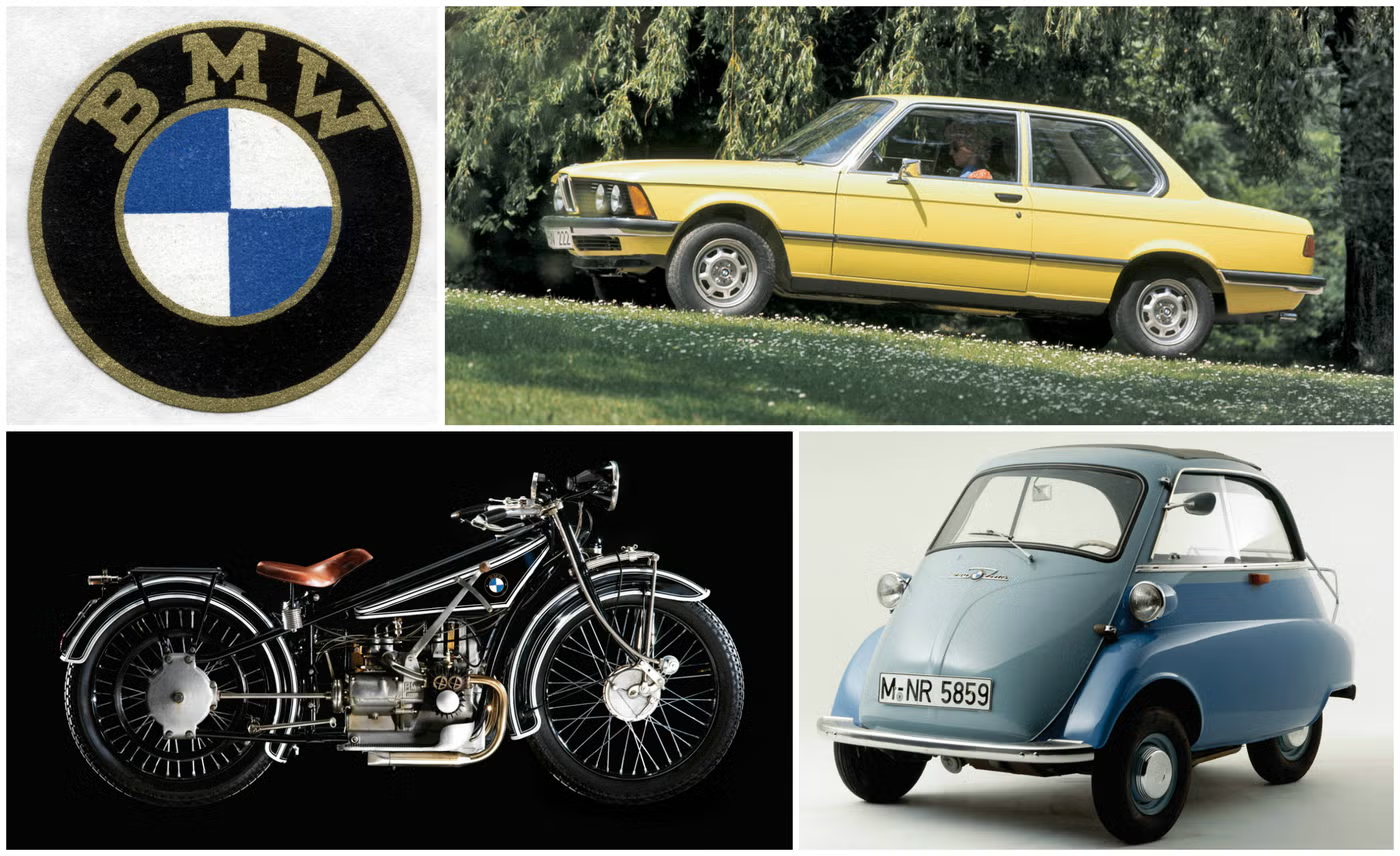
In 1923, BMW introduced the R32, the first motorcycle to carry the brand name. More than a first attempt, the R32 was a profound statement of identity. It featured the flat-twin boxer engine and shaft-drive configuration that would become a hallmark of BMW motorcycles. In one move, BMW established a distinct technical language in a new category. That was a pattern the company would repeat throughout its history: when pushed into a new chapter, it rarely entered quietly. It tried to define the terms.

The boxer layout gave BMW’s motorcycles a character that was both visual and mechanical. The cylinders projected confidently into the air, the shaft drive reinforced an image of durability and refinement, and the whole machine looked different from many of its contemporaries. BMW was not simply making motorcycles to stay alive. It was already beginning to show the tendency that would later define its cars: a willingness to treat engineering choices as part of brand identity.
BMW’s entry into the automobile world came a few years later, in 1928, when it acquired Fahrzeugfabrik Eisenach. That acquisition gave the company a path into car manufacturing through the production of the BMW 3/15, often referred to as the Dixi. Based on the Austin 7, the Dixi was not yet a pure expression of later BMW character, but it was an essential industrial step. It gave the company production experience, market access, and a foothold in the automotive business.
Historically, the Dixi sometimes sits in the shadow of later icons, but its importance cannot be overstated. Without it, BMW’s evolution into a carmaker would have been slower and more uncertain. It served as the company’s apprenticeship in automobile manufacturing. It taught BMW how to build cars at scale, how to serve buyers beyond the specialist world of engines and motorcycles, and how to participate in a fast-changing consumer market.

As the 1930s unfolded, BMW began to discover the qualities that would later define its public image: lightness, performance, mechanical elegance, and motorsport credibility. The company developed more ambitious road cars, but the model that most clearly announced BMW’s sporting promise was the 328. Introduced in 1936, the BMW 328 became one of the great sports cars of its era. It was not only a beautiful and efficient machine but also a highly successful competition car, achieving important victories including success at the Mille Miglia.
The 328 mattered because it provided BMW with more than sales or trophies. It gave the company identity. Here was a car that united engineering sophistication with real dynamic ability, and it did so in a way that people remembered. The 328 planted the seeds of the modern BMW myth: a belief that the brand’s truest expression lay in combining elegant engineering with performance that felt alive, responsive, and honest.

Then, as with so many European manufacturers, the Second World War changed everything. BMW returned to wartime production, particularly aircraft engines, and the conflict left the company deeply damaged. Factories were destroyed, industrial capacity was shattered, and the political and economic landscape of Germany was transformed. In the aftermath, BMW faced one of the most precarious moments in its history. It had technical skill, but its industrial future was uncertain.
Recovery was slow and difficult. The company restarted with motorcycles before returning more fully to automobiles. The 1950s were especially tense. BMW produced cars such as the 501, which represented a desire to operate in the upper segment of the market, but commercial success remained elusive. The company seemed caught between aspiration and economic reality. It could build elegant, sophisticated vehicles, yet those alone were not enough to guarantee survival.
In that difficult period, one of BMW’s most historically important products was also one of its smallest: the Isetta. This microcar, famously compact and unconventional, helped keep the company alive at a time when affordable mobility mattered more than prestige. The Isetta did not resemble the BMW that later enthusiasts would celebrate, but it was essential. It is one of the clearest examples in the company’s history of survival taking precedence over image.

Even in that fragile era, BMW still produced cars that hinted at another future. The 507, for example, became one of the most beautiful roadsters the company ever built, but it was too expensive to save the firm on its own. The broader problem remained unresolved: BMW still needed to discover the product formula that could combine commercial success with a clear and lasting brand identity.
That breakthrough came in the 1960s with the Neue Klasse. It is difficult to overstate how important this chapter was. The Neue Klasse cars, beginning with models like the BMW 1500 and culminating in key variants such as the 2002, effectively created the modern BMW. These cars established the template that would define the company for decades: compact-to-midsize premium cars with engaging dynamics, advanced engineering, practical usability, and an unmistakable driver-first spirit.
The Neue Klasse did more than rescue BMW financially. It gave the company a coherent philosophy. Here, at last, was the formula that linked brand image, business success, and engineering character. These were not luxury barges in the old sense, nor were they stripped-down economy cars. They were intelligently packaged, lively, premium cars aimed at people who valued driving. In a sense, nearly every important BMW that followed owes something to this moment.

The 2002, in particular, became one of the key models in the company’s history. Small, direct, agile, and mechanically charismatic, it demonstrated that a premium sports sedan could be practical and genuinely enjoyable. The 2002 helped BMW connect with a broader audience of enthusiasts and established a reputation that would eventually feed directly into the 3 Series legend. The notion that BMW built cars for people who loved to drive became much more believable after the Neue Klasse cars proved it in practice.
The next major phase of this story came through motorsport and the creation of BMW Motorsport GmbH in 1972, the organization that would become BMW M. This division did not invent BMW’s sporting instincts, but it sharpened them into a more explicit and globally recognizable performance identity. BMW M became the concentrated form of everything enthusiasts already admired about the brand: precise handling, strong engines, disciplined engineering, and motorsport legitimacy.
Cars like the BMW M1 helped define this new aura. The M1 showed that BMW was willing to build a purposefully exotic machine if it served the brand’s competitive ambitions and emotional image. Later, the M3 and M5 would turn that spirit into road-going icons. The E30 M3 became a benchmark for compact performance cars, while the M5 proved that a practical executive sedan could also be a serious driver’s machine. The power of BMW M lay not only in speed but in credibility. It was an extension of the company’s real engineering culture, not a costume draped over ordinary products.

Through the late twentieth century, BMW expanded into a structured global premium brand. The 3 Series, 5 Series, and 7 Series became the backbone of its lineup. These model families allowed the company to grow while preserving the central ideas that had emerged during the Neue Klasse era. The 3 Series represented accessible sporting refinement, the 5 Series balanced executive presence with dynamic competence, and the 7 Series allowed BMW to compete at the top of the luxury market without abandoning engineering seriousness.
Part of BMW’s strength lay in how consistently it tied its image to engines, balance, and driver involvement. Inline-six powerplants became almost a signature. Rear-wheel drive remained a core architectural choice for much of the company’s most important history. Steering feel, chassis poise, and weight distribution were discussed as essential parts of the brand’s value proposition. BMW was not merely selling prestige. It was selling an idea of how a premium car should behave.
This became especially powerful in contrast to its main German rivals. Mercedes-Benz often projected solidity, tradition, and comfort. Audi increasingly leaned into technical modernity, all-wheel-drive sophistication, and visual restraint. BMW carved out a distinct lane by emphasizing the pleasure of driving. This did not mean every BMW was raw or extreme. Rather, it meant the brand made a point of telling buyers that engineering refinement should be felt at the wheel, not only seen in marketing language.
Yet BMW also changed with the market. The rise of SUVs and crossovers reshaped the premium sector, and BMW responded with the X range. Purists sometimes saw this as a departure from the brand’s essence, but from a business perspective it was a necessary adaptation. BMW could not remain a global luxury powerhouse while ignoring the way customers were shifting. The challenge was to translate its identity into new forms without losing coherence. The company tried to do so by giving even its larger vehicles a sense of dynamic discipline and premium engineering integrity.
The modern era also brought increasing complexity in design, electronics, safety systems, and global manufacturing strategy. BMW became not just a maker of cars but a global industrial network capable of serving diverse markets with different priorities. China grew in importance. Sustainability became more pressing. Digital interfaces and software began to matter almost as much as traditional mechanical virtues. In this environment, BMW faced the same question that has confronted many historic manufacturers: how do you modernize without dissolving your core identity?
Electrification is one of the clearest expressions of that challenge. BMW approached the electric future in a distinctive way. The i sub-brand, launched with cars such as the i3 and i8, allowed the company to experiment with new forms, materials, and engineering concepts. The i8, in particular, became a symbolic flagship for the brand’s futuristic ambition. It was dramatic, efficient in concept, technologically ambitious, and visually unlike almost anything else on the road. Even people who never owned one understood that BMW was trying to define its place in a new era.
The i3 and i8 did not by themselves transform the entire company, but they were culturally significant. They showed that BMW was willing to experiment early and publicly with electrified and alternative-construction vehicles. Later, products such as the i4 and i7 extended the company’s electric ambitions into more conventional premium segments. These models suggested that BMW’s future would not be built around a separate experimental island, but around integrating electrification into the mainstream brand structure.
The i4 is especially interesting in this context because it interprets the electric transition through a familiar BMW lens. Rather than presenting itself as a radical break from the brand’s history, it offers electrification within a format that still feels recognizably BMW: a stylish premium performance-oriented car with strong everyday usability. This is how BMW has often managed transition in the past. It rarely abandons its old identity in one stroke. Instead, it tries to translate that identity into new technical realities.

Looking across the whole history of BMW, the strongest pattern is not simply performance, luxury, or even engineering excellence by themselves. It is adaptation through engineering. Again and again, the company encountered moments when its old business model or product strategy was no longer sustainable. Again and again, it responded not by becoming generic, but by using technical choices to redefine its future identity. Aircraft engines gave way to motorcycles. Motorcycles were followed by small cars. Sports cars forged a reputation before war disrupted everything. Microcars bought time. Neue Klasse created a modern premium formula. M cars amplified the sporting myth. Electric models now attempt to translate that myth into a new industrial era.
This helps explain why BMW continues to fascinate enthusiasts and historians alike. It is not simply a company with a long list of famous models. It is a company whose most important products often arrived at moments of real strategic significance. The R32, the 3/15, the 328, the Isetta, the 1500, the 2002, the M1, the M3, the i8, and the i4 each represent more than individual vehicles. They are markers in the ongoing story of how BMW repeatedly discovered new ways to be itself.
That is also why the brand’s slogan, famous as it is, only captures part of the truth. “The Ultimate Driving Machine” speaks to the emotional and dynamic side of the company, and for many of its greatest cars that phrase fits beautifully. But the longer history of BMW also includes something broader: a relentless effort to align industrial survival, engineering ambition, and brand identity. Many companies can build good cars for a period. Fewer can do so across wildly different eras without losing the thread completely.
In the end, BMW’s story is not just about motion. It is about reinvention with memory. The company changed because it had to, but it rarely changed without trying to preserve some deeper engineering continuity. From the IIIa to the R32, from the Dixi to the 328, from the Isetta to the Neue Klasse, from BMW M to the electric i range, the brand’s history reveals a company that kept redefining itself while remaining unmistakably BMW. That is why its past still feels alive in its present, and why its future will continue to matter to anyone interested in the evolution of the automobile.
Share this content:

Post Comment